R.Code for Claude Code
Build smarter. Build better.
A complete, portable Claude Code setup that gets better from its own work — every change reviewed by you. Guardrails that hold, a team of specialist agents, a live Cockpit for your terminal, and a framework that never learns your real names.
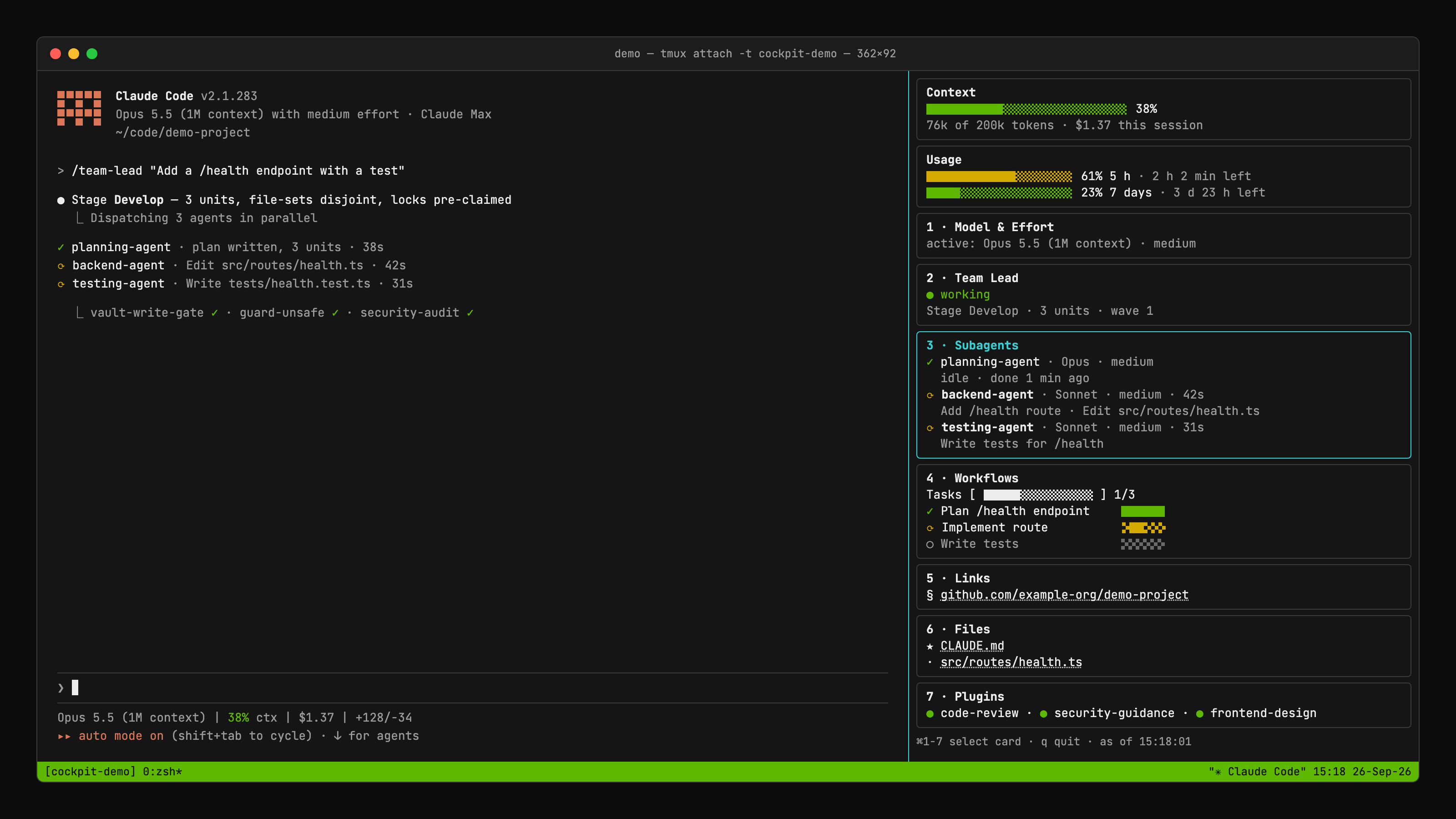
Live components from the R.Code for Claude Code design system, with demo data — see Cockpit for the full seven-card dashboard.
1 · It gets better on its own — with you as the gate.
Every session leaves signals: friction, corrections, repeated fixes. A routine turns them into concrete proposals for new or changed rules. You review every one — nothing changes the framework without your approval. In the maintainer’s own setup, 172 improvements have been implemented this way so far.
2 · Guardrails that don’t negotiate.
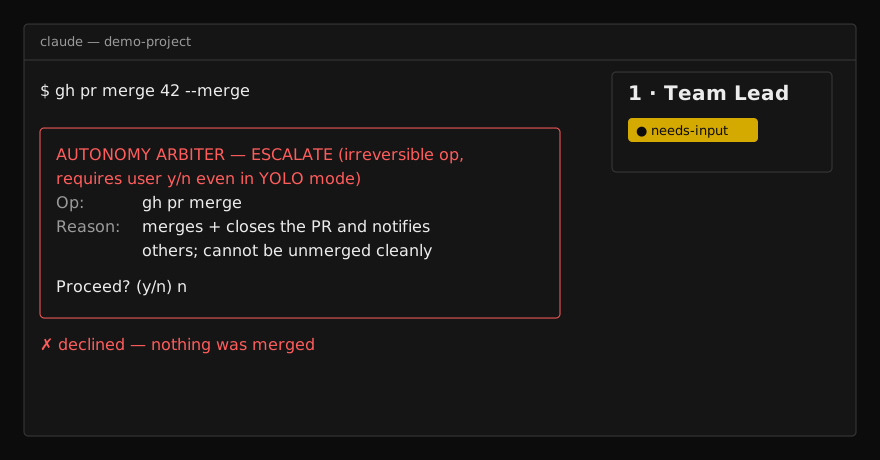
Deterministic gates run before every tool call — no language model in the gate. Dangerous commands, force-pushes, production migrations and secret leaks are stopped before they run; anything irreversible always gets a human yes/no, even in autonomous mode.
3 · A team, not a chatbot.
Twelve specialist agents — planning, backend, testing, review, UI, research and more — dispatched in parallel on locked file sets. /team-lead decomposes the work, delegates it and reviews every wave.
4 · See it in the Cockpit.
A tmux sidebar next to Claude Code: context and cost, running subagents, workflow progress, links and files — updated live from the same hooks. (Companion repo: claude-cockpit; screenshots show demo data.)
5 · Pseudonymized by design.
Real project names, machine paths and personal identifiers live only in a local vault. Every write, every commit and every publish is checked: 0 real values in any tracked file.
The self-improvement loop
R.Code learns from its own friction — reviewed by you before anything lands.
- Every edit and session-end event is captured as a lightweight signal.
- Once enough accumulate, a routine synthesizes them into concrete proposals for new or changed rules.
- You review every proposal — nothing is applied automatically.
- Accepted proposals land in the rules that are always loaded, so the next session starts smarter.
21 always-loaded rules, 22 commands, 51 skills, 12 agents, 42 hooks, 3 scheduled routines (tracked in the published repo)
28 regression suites, 1,100+ assertions, all green before every release
14 deterministic gates a session meets (guard-unsafe, agency gates, secret scan, vault gate, file/config protection …)
MIT license · macOS, Linux, Windows · one-line install
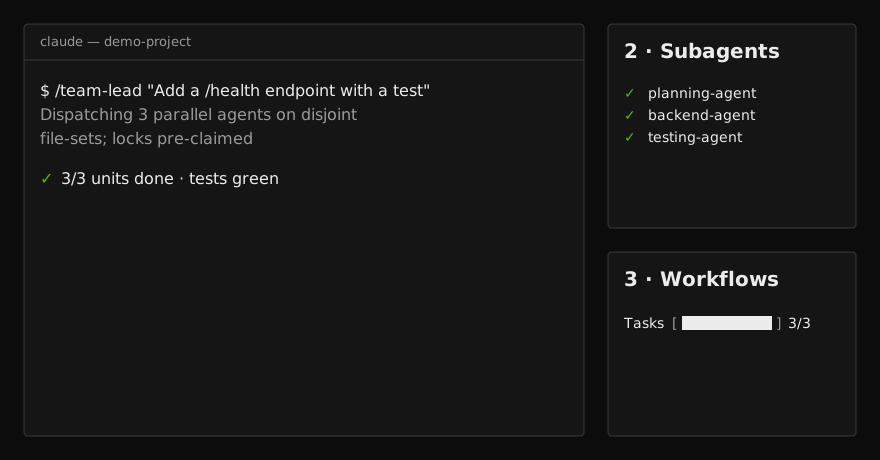
/team-lead decomposes the work, delegates it and reviews every wave.Install in one line
bash <(curl -fsSL https://raw.githubusercontent.com/emanuelrechsteiner/claude-rcode/main/install.sh)